Plumbing permits and licensing in Central Texas — what actually applies to your house
Two different worlds
Texas has no single statewide building code. Codes are adopted locally. Texas Local Government Code section 214.212 makes the International Residential Code the municipal residential building code for one- and two-family dwellings, and section 214.216 does the same for the International Building Code on commercial buildings. But the plumbing provisions are adopted by each individual municipality, and which edition of the code a city has adopted varies from city to city.
Inside a city's limits, the city building department is the authority — permit, plan review and inspection. The city decides what needs a permit, what the fee is, and which edition of the code applies. Before any work starts, the permit gets pulled, and when the work is done, an inspector comes out to sign off on it.
In unincorporated county areas, most rural Texas counties do not enforce a building or plumbing code at all. County authority is generally limited to floodplain regulation, on-site sewage facilities and subdivision platting — none of which covers the plumbing inside your house.
That is the split. Inside the line, somebody is watching. Outside it, usually nobody is. The same job, two addresses ten miles apart, can be two completely different permitting situations. And most homeowners do not know which side of the line they are on until somebody tells them.
Inside city limits
If your house is inside a city's limits, the city building department handles the permit, the plan review and the inspection. The work has to meet the code edition that city has adopted.
The specific permit fee and the adopted code edition differ from city to city, and the only reliable way to know is to call that city's building department. JK Ranch pulls the permit wherever one is required, so you do not have to deal with it yourself — but the fee and the process are set by the city, not by the plumber.
Out in the county
In the unincorporated parts of Lee, Milam, Burleson, Fayette and Washington counties — and the rural parts of the rest of the service area — there is usually no plumbing permit pulled and no inspection at all. Nobody is coming to check the work. You pull a permit inside city limits because the city makes you. Out in the county, there is nobody to pull it from, so nobody does.
That does not mean the work does not have to be right. The code still exists as the standard, and it is what the next inspector, appraiser or buyer's inspector will measure the work against when the house changes hands. It means the only real check on the quality, out in the county, is the plumber's state license and their willingness to do it properly when nobody is watching.
This is the part a lot of people do not think about. Inside city limits, the city inspector is the backstop — if the plumber cuts a corner, the inspector catches it and makes them fix it before the permit closes. Out in the county, that backstop is gone. There is no second set of eyes. The work either gets done right the first time, or it does not, and the only person who knows the difference is the one doing it.
That is exactly why the license number matters more out here, not less. Inside city limits, the city inspector is a backstop. Out in the county, there is no backstop — just the license, and the person whose name is on it. A plumber who does good work when nobody is checking is the same plumber who does good work when somebody is. A plumber who only does good work when the inspector is watching is not the one you want with nobody watching.
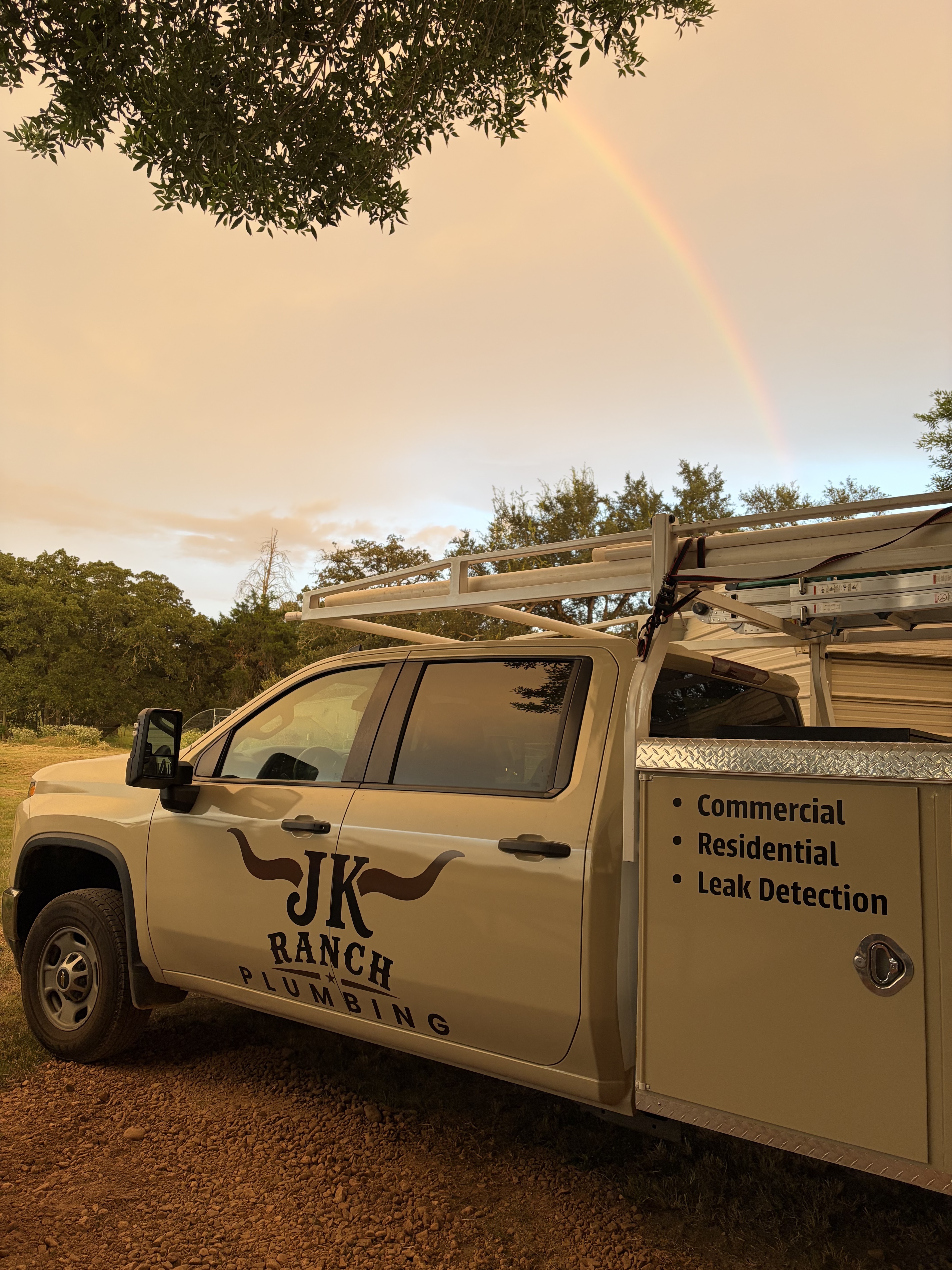
JK Ranch's RMP is Jacob Pryor, license M-47091. It is on this site, on the truck, and on every proposal. The work gets done to code either way, because the code is the standard whether somebody is watching or not.
How to check any plumber in Texas in about two minutes
- Ask for the Responsible Master Plumber license number. A plumbing company has to operate under an RMP, and the number is the thing that can actually be verified.
- Look for it on the truck and on the written proposal. Texas rule 22 TAC 367.10 requires the RMP license number and the company name on both sides of every service vehicle, in letters at least two inches tall, in a contrasting colour, preceded by "M", "MPL" or "RMP". The same rule requires it on the proposal.
- Look the number up on the Texas State Board of Plumbing Examiners website at www.tsbpe.texas.gov to confirm it is active and held by the person who says they hold it.
- Ask for a certificate of insurance. A licensed plumber who is insured will hand one over.
A company advertising plumbing services without a license number displayed is not meeting the advertising rule. That is a signal worth noticing, not a formality.
What the law requires a plumber to show you
Texas rule 22 TAC 367.10 requires that all advertisements by a plumbing company designed to solicit plumbing business state the license number of the Responsible Master Plumber of record, regardless of the type of media used. A website is advertising. A plumbing website with no license number on it is a signal worth noticing.
The same rule requires the RMP license number and the company name on both sides of every service vehicle, in letters at least two inches tall, in a contrasting colour, preceded by "M", "MPL" or "RMP". So the truck should have it, big enough to read from the curb.
The same rule requires that contracts and proposals carry, on the first page, the RMP's first and last name, the RMP license number, the phrase "regulated by the Texas State Board of Plumbing Examiners", and the Board's contact details, at 12 point type or larger. So the proposal should have it too.
The Board can be reached at 7915 Cameron Road, Austin, Texas 78754, (512) 936-5200, and license status can be looked up at www.tsbpe.texas.gov.
Where JK Ranch stands on this
Jacob Pryor is the RMP, license M-47091, displayed on this site, on the truck and on every proposal. JK Ranch pulls the plumbing permit wherever one is required. The work is done to code either way, because the code is the standard whether somebody is watching or not.
Common permit questions
Do I need a permit to replace a water heater?
Inside city limits, usually yes — call your city's building department to confirm, because the specific requirement and fee vary by city. Out in unincorporated county areas, there is usually no plumbing permit at all. Either way, JK Ranch pulls whatever permit is required.
Do I need a permit to replace a sewer line?
Inside city limits, yes — a sewer line replacement is the kind of work a city building department inspects. The fee and the process vary by city, so call that city's building department for the specifics. Out in the county, there is usually no permit and no inspection.
What if I'm outside city limits?
In unincorporated parts of these rural counties, there is usually no plumbing permit and no inspection. The work still has to be done to code, but nobody is coming to check it. That is exactly why the plumber's state license matters more out there, not less.
Who inspects the work in the county?
Usually nobody. Most rural Texas counties do not enforce a building or plumbing code. County authority is generally limited to floodplain regulation, on-site sewage facilities and subdivision platting. The only real check on the quality of the work is the plumber's license and their willingness to do it right when nobody is watching.
Does my county have a building code?
Inside the city limits of a town in that county, yes — the city has adopted a code. Out in unincorporated county areas, most of these counties do not enforce a building or plumbing code. Which edition of the code a city has adopted also varies from city to city.
Can I pull the permit myself as a homeowner?
In some cities a homeowner can pull a permit for work on their own residence, but the rules and the required inspections vary by city. Call your city's building department before you decide to do it yourself rather than having JK Ranch pull it.
What happens if work was done without a permit and I'm selling?
A buyer's inspector or the buyer themselves may flag work that was done without a permit, and it can hold up a sale. Call your city's building department to ask what is required to bring it onto the record. The honest answer varies by city and by what was done.
How do I look up a plumber's license?
Go to the Texas State Board of Plumbing Examiners website at www.tsbpe.texas.gov and search the license number, or call the Board at (512) 936-5200. JK Ranch's RMP is Jacob Pryor, license M-47091.
This page is general information about how permitting works in Texas, not legal advice. The city or county with jurisdiction over a specific address is always the final word on what is required there.
Have a permit question for your address?
Call Jacob. He will tell you straight whether a permit applies and pull it if it does. Free estimates on any job.
Call (979) 206-0888Monday to Saturday, 6:00 AM to 10:00 PM. Closed Sunday.